
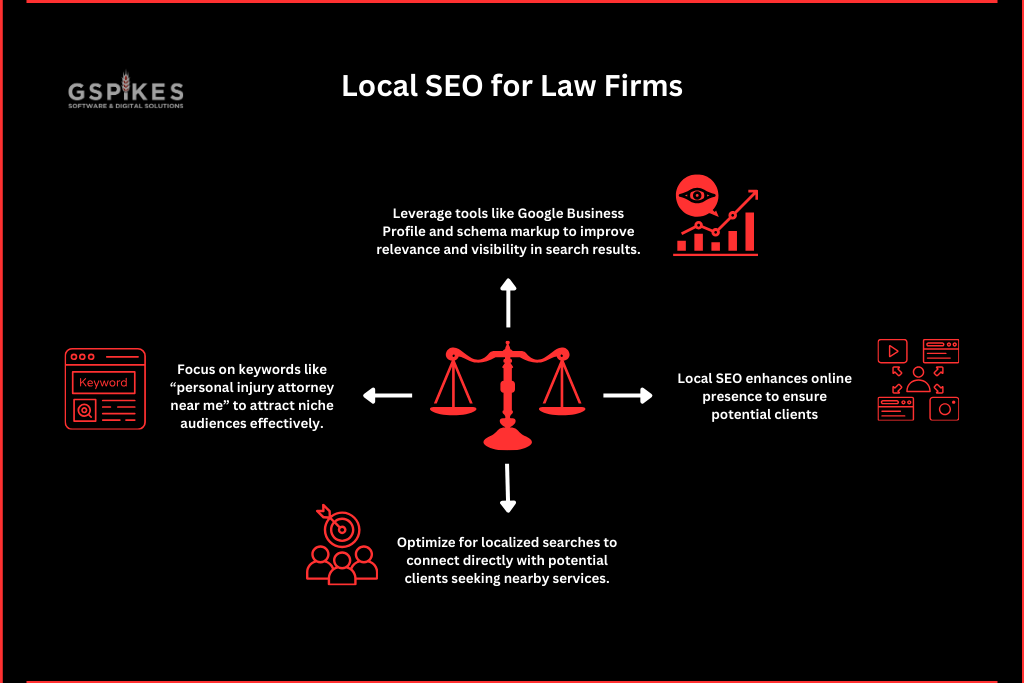
Local SEO is fundamental for law firms, as it connects those legal services with clients who are looking for them in their local community.
With strategic optimization of digital assets, law firms can enhance their visibility and draw in potential clients actively seeking legal assistance in their local area.
To do so, this method hones in on tactics such as GBP (Google Business Profile) optimization, local keyword targeting, and maintaining consistent directory listings.
We know that the legal industry is one of the most competitive industries to be in.
Local SEO ensures your firm stays at the top of your mind and within reach of those who need you most.
What Is Local SEO for Law Firms

Definition of Local SEO
Local SEO is the practice of increasing a business’s online visibility within localized search engine results. Small law firms must do everything possible to ensure that potential clients can find them. This is crucial for anyone searching for legal help from a local lawyer.
The aim is to reach people directly who are conducting focused searches for legal services in their area. A significant part of this involves optimizing local business listings, including the basics like claiming and verifying your Google Business Profile. Your profile maximizes your firm’s visibility in the Local Pack, which is vital for any new law firm.
This feature guarantees substantial visibility to the best local businesses right on the search results page. Local keywords, such as “family lawyer Dallas” and “personal injury attorney near me,” are critical to these strategies. They allow law firm SEO to target niche audiences effectively.
By utilizing these keywords, your firm can appear in the most relevant searches, putting you in the best position to be contacted. Technical SEO strategies, such as schema markup, can further enhance visibility. This specific type of code helps search engines better understand your content, surfacing your expertise in specific practice areas and geographic locations.
This can improve your visibility by surfacing your expertise in specific practice areas and geographic locations. This helps search engines better match your site with pertinent local searches. When you create the perfect mix of these components, your law firm will be more visible online.
Adopting a local SEO campaign will significantly improve your local search presence and overall success in the legal market.
Importance of Local SEO for Lawyers
It’s the local touch that brings clients in when they need legal help most. Studies have found that 61% of mobile users are ready to contact a local business on mobile-optimized sites. This further underscores the importance and urgency for law firms to develop a mobile-optimized online presence.
This is especially important for time-sensitive legal issues. Those in need of legal help typically look for local support on their mobile device. Winning that local market competition puts a large emphasis on local SEO.
Many firms just play the basics, like optimizing their Google Maps listings. They take the initiative to get positive reviews from clients, boosting their online presence. In fact, a fully optimized and regularly maintained Google Business Profile is one of the most reliable and affordable lead-generating methods available.
Law firms had a whopping 421% ROI from non-paid marketing efforts. They did this by doubling down on their local SEO strategies and tactics. This is just one example of the clear difference local SEO can make on a law firm’s overall success to reach clients who need their help.
How Local SEO Differs from General SEO
While regular general SEO focuses on a wider audience, local SEO focuses on the search results based on specific locations. It primarily involves targeting local keywords and optimizing your business’s local business listings.
Plus, it helps guarantee your NAPW (Name, Address, Phone number, Website) info is up to date and consistent everywhere. Local SEO includes getting involved with the community, like sponsoring local events or working with other nearby businesses.
These fun activities foster community trust and increase local citations, defined as mentions of your business on other websites. The Local Pack is another key difference. This feature is present in nearly every search with local intent.
That’s why local SEO is a game-changer for law firms looking to convert local leads. By focusing on location-specific tactics, law firms can better differentiate themselves, providing an advantage over competitors who focus only on general SEO strategies.
Benefits of Local SEO for Law Firms

Attracting Clients in Your Area
In short, local SEO is extremely important for law firms. Additionally, it allows them to target potential clients who are already searching for legal services in their local area. By targeting location-specific keywords, law firms can increase their chances of appearing in local search results.
For instance, those keywords would be terms such as “personal injury attorney in Austin,” or “family lawyer close to Chicago.” This direct line to local searchers boosts the chances of getting inquiries from clients who are intent to act. A law firm that primarily practices real estate law in San Diego would want to rank for terms such as “property dispute attorney San Diego.
This targeted strategy draws in homeowners and landlords who can benefit from urgent help. Local advertising is important in terms of this too. Optimizing for Google Maps and local business directories like Justia and Avvo can drive up to 25% of qualified client inquiries.
Listings with photos and a complete business profile get 42% more requests for directions. Perhaps unsurprisingly, they receive 35% more click-throughs, indicating that eye-catching images combined with information-laden content increase user engagement. These growing tactics all directly support your law firm’s client acquisition efforts, paving the way to real, measurable results.
Increasing Online Visibility Locally
Increasing visibility in local search is probably the most immediately obvious benefit of local SEO. When someone searches “law firm near me,” optimized local SEO ensures your firm shows up in the results, often within Google Maps or at the top of organic listings.
Regularly updating your site with fresh, local content – like blog posts – and staying engaged with your clients by actively managing your review profile – will ensure you rank even higher. As we reported last year, research indicates that a mobile-friendly website is a must. After all, 61% of mobile users are more likely to contact a business with a site that’s mobile-friendly.
A well-optimized Google Business Profile (GBP) is essential. It’s one of the most cost-effective tools for driving new leads, with a typical return of 421% on non-paid local SEO efforts. An optimized GBP allows law firms to showcase their services, business hours, and reviews from their former and current clients.
These elements are key to earning more clicks and calls. Profile-driven calls increased by as much as 295%. This easy but calculated tactic can significantly increase your law firm’s local visibility.
Building Trust and Credibility in the Community
Beyond that, local SEO builds trust by helping to establish your law firm as a trusted resource within the community. Positive reviews on Google, Yelp, and other local directories establish your credibility. This makes it more likely that potential clients will choose you over the competition.
Getting involved with your community through local events or content creation—like blogging about local legal issues—bolsters your reputation even more. The better you’re able to establish yourself as a part of your local market, the more trust you’ll build with potential clients.
Enhancing Competitive Edge in Local Market
Lastly, local SEO gives you a valuable competitive advantage by setting your firm apart in a county full of other law firms. Keeping up with local SEO trends will help you keep your strategies effective, even as algorithms and searchers’ behaviors change over time.
A law firm with a focused, single-objective landing page can achieve conversion rates of 8.33%, outperforming the 6% average across industries. Google Maps leads are an incredible value, averaging $45 to $85 per lead.
By comparison, legal keywords on Google Ads can cost you between $150-$350 per lead. That cost efficiency means that local SEO is a smart investment for law firms that want to make a mark.
How Google Ranks Law Firms Locally

Several factors contribute significantly to your local search presence and rankings. Each aspect is crucial for how your small law firm gets ranked in local search results. Google evaluates a combination of relevance, distance, and prominence to determine the ranking of local law firm listings, which is essential for effective local SEO services.
Relevance ensures that search results align perfectly with user needs, while distance assesses how far the business is from the searcher. Prominence, on the other hand, gauges the firm’s overall reputation within the legal market. Together, these elements enable Google to deliver the most accurate and useful results, especially for many law firms looking to enhance their visibility.
By understanding these criteria, law firms can strategically improve their online presence. This knowledge empowers them to boost the visibility of their clients, making them more accessible to potential local customers through a tailored local SEO campaign.
Understanding the Local Pack
Google’s “local pack” feature is designed to highlight three of those businesses at the top of local search results. These listings are typically accompanied by a map to help users find their way. When you search for “personal injury lawyer near me,” Google will feature three local firms at the top.
These are the ones it considers to be the most relevant, most reputable, and most nearby. This local pack pretty much changes the entire playing field for law firms. It dramatically improves visibility and can lead to a massive increase in new client leads.
Properly optimizing a firm’s Google Business Profile (GBP) should be one of the most important moves a firm makes to earn a position in the local pack. Complete and accurate information, such as address, phone number, website, and operating hours, ensures Google has the data needed to rank the firm effectively.
Including as many high-quality images as possible, responding to reviews, and adding relevant business categories will go a long way in maximizing the profile’s performance. Taking these steps will help lay the groundwork for local SEO success.
Key Factors Influencing Local Rankings
Proximity to the searcher is very important. It’s no secret that Google favors businesses close by when users perform searches based on location. High-quality, consistent, accurate business information across every platform—GBP, legal directories, and local citations—establishes trustworthiness and expertise.
For example, inconsistent address or phone number listings mislead clients and hurt law firm rankings. We all know that positive reviews and ratings are huge. Your law firm will have a much better chance of ranking higher and attracting the right clients if you have many 5-star reviews.
Proactively encouraging satisfied clients to leave positive reviews and quickly addressing or learning from negative feedback will go a long way to cultivating a healthy online reputation.
Role of Proximity and Searcher Intent
As Google’s ability to detect a user’s location has increased, so too has the importance of proximity as a ranking factor. For example, when a potential client searches for “estate planning attorney,” Google wants to show them the most relevant results closest to them.
Searcher intent is just as important. A user looking for “how to file a lawsuit” may require educational content, while “divorce attorney near me” suggests an immediate need for legal services. Law firms can increase relevance by utilizing local keywords, such as city or neighborhood names, throughout their website and GBP.
Other Ranking Considerations for Lawyers
Website optimization is another big piece of the puzzle. Things such as site speed, mobile-friendliness, and overall user experience can directly affect rankings. Users will quickly bounce from slow websites, telling Google that your website is providing a bad user experience.
High-quality, well-written content that answers frequently asked client questions can help improve rankings, too. Local backlinks, like links from local hospitals, community organizations, or local media, help establish a firm’s authority.
Whether it’s participation in local events or sponsorships, engaging with the local community builds credibility, community ties, and overall visibility. Lastly, law firms need to invest in long-term strategies, not be thrown off by the day-to-day ranking changes. Ongoing work in SEO produces results that are sustainable and stand the test of time.
Setting Up and Optimizing Google Business Profile
A well-optimized Google Business Profile (GBP) is foundational for local SEO services, especially for small law firms aiming for local search engine optimization success. It’s more important than ever for law firms to enhance their local search presence and reach potential clients in their geographic area.

1. Choosing the Right Business Name
Having the right business name can make a big difference for local search visibility. In general, it’s important to choose a name that unambiguously describes your law firm’s services and location. A name such as “San Diego Family Law Firm” makes it obvious what you do.
It injects a valuable geographic element, which helps you dominate the local SEO even further. Remember, consistency is key! Ensure your business name is consistent across the web—your website, legal directories such as Avvo and FindLaw, and your social media accounts.
This consistency makes it easy for Google to confirm your credibility, and you’ll rank higher in searches as a result.
2. Selecting Accurate Business Categories
Selecting categories that best match your practice areas is another important step. For example, if your law firm focuses on personal injury, set your primary category to “Personal Injury Attorney.” This is a much better option than selecting a catch-all “Law Firm” tag.
You can add secondary categories like “Workers’ Compensation Attorney” to show that you provide those services. By regularly reviewing and updating these categories, you can make sure that your profile stays relevant as your services continue to expand or change.
3. Adding a Verified Address and Contact Information
This will create credibility with Google and show potential clients that you are a legitimate business. Add a verified street address, phone number, and email to make sure potential clients can easily find and contact you.
Google cross-references this information with legal directories such as FindLaw to ensure correctness. Keeping your NAP (Name, Address, Phone) consistent across every listing pushes your local SEO strategy to another level.
4. Writing a Compelling Business Description
Your Google description section is your chance to speak to your expertise straight to the people looking to hire you. I provide highly skilled, effective criminal defense throughout Chicago, using more than two decades of experience.
It is my solemn promise to safeguard your rights and secure the most favorable resolution for your case. Make sure to incorporate important local keywords such as “Chicago criminal defense attorney” to improve your profile’s search visibility.
5. Uploading Optimized Photos and Videos
Rich, high-quality visuals help your profile stand out. Upload high-quality photos of your office, your team, and potentially even client testimonials in video format. Optimize these files by naming them descriptively (i.e. Los-Angeles-Family-Law-Office.jpg) and adding alt text to enhance SEO.
Visuals are your opportunity to really humanize your firm and get potential clients to start picturing themselves working with you.
6. Managing Reviews and Responses Effectively
Client reviews are a key component to local SEO and reputation management. Get your happy clients to leave glowing reviews and try to answer all of them quickly. For instance, show appreciation to clients who leave positive reviews and respond to any negative feedback in a respectful manner.
This proactive approach not only builds trust with potential clients but sends positive signals to Google that your firm is active, engaged, and client-focused.
7. Verifying Your Google Business Profile
Verification is key to gaining full control over your profile. Google usually verifies your listing by sending a postcard with a verification code to your listed address, which you’ll enter online. This process helps reassure both Google and future customers of your legitimacy.
A verified profile helps you stand out in local search results. It opens the door to other paid features, such as Local Services Ads, which can put you in front of even more potential customers.
Creating Localized Content for Law Firms
This is why creating localized content is incredibly important, as it can be the key to helping law firms reach clients in their geographic area. By addressing local legal concerns, using region-specific keywords, and creating targeted landing pages, firms can improve their visibility and build trust with the community they serve.
Save the Children’s practical strategy to do so is all outlined below.
Identifying Relevant Legal Keywords

In the world of local SEO, keyword research isn’t just a one-time activity—it’s a continual practice. Law firms should instead be looking to hone in on high-value local search terms that best match the legal issues your prospects need help with.
For instance, a personal injury law firm in Florida could target keywords like “Florida car accident lawyer” or “no-fault insurance attorney in Miami.” These phrases are very closely related to what users are searching for and what they need legally.
To stay competitive, you need to go back and regularly update your keyword strategies as the search landscape changes over time. Tools such as Google Keyword Planner or SEMrush can be invaluable in uncovering which terms are beginning to catch fire.
Identifying seasonal search behavior is important for every firm. For instance, they can take advantage of the spike in searches for “San Francisco tax attorney” around tax season.
Writing About Local Legal Issues

Localized content that goes in depth on local issues establishes your authority and helps your law firm stand out from the rest. Blog posts, FAQs, and case study articles explore new and interesting topics.
They dive into New Jersey’s attorney-client privilege legal precedent and recent updates to California’s tenant laws. These free tools provide incredible insight to the users reading your content. Plus, they position your firm as a thought leader in the local legal landscape.
When you address these issues, you build trust and encourage engagement. A local blog post like “Know Your Tenant Rights in San Francisco” can bring in renters searching for legal guidance.
Moreover, it can effortlessly string in local keywords to make the content even more relevant. Informative and localized content attracts interest. It speaks volumes to search engines and potential clients alike.
Developing Location-Specific Landing Pages

Dedicated landing pages targeting each relevant practice area and location are one of the most fundamental aspects of a successful local SEO strategy. A family law firm serving multiple cities could create pages like “Divorce Lawyer in Oakland” and “Child Custody Attorney in San Jose.
These pages give you the opportunity to target very specific search queries, all the while demonstrating your expertise and authority in each respective field. Further, to maximize their impact, these pages should feature local keywords, testimonials from local clients, and imagery that is representative of the area.
Combine this with a highly-optimized GBP. Make sure it has correct NAP information—name, address, phone number—to get consistent and authoritative information everywhere online.
Incorporating Local Events into Content Strategy
Whether sponsoring an event or participating, these localized efforts create great opportunities for a firm to engage. For instance, a firm sponsoring a San Francisco charity run could create a blog post about the event, highlighting its involvement and sharing pictures on social media.
Platforms like Facebook and Twitter have proven super effective at spreading this kind of content. They encourage engagement and help increase exposure in your local market. Not only does this strategy make your firm more discoverable and relevant to local audiences, but it has the potential to earn high-quality backlinks.
A backlink from the event’s website or a local news outlet that covers your sponsorship further establishes authority to your site. These community events provide a perfect opportunity to join forces with other local businesses. You can find these local businesses easily browsing a directory or your local Chamber of Commerce.
Building Authority Through Local Citations and Links
Local citations and backlinks aren’t just nice to haves, they’re fundamental for law firms looking to build up authority and stand out from the pack in their local communities. These pieces help improve their search engine rankings through local citations and links. They further earn the trust of potential clients by exhibiting the most credible digital presence possible.
Let’s unpack that a little more.
Importance of Accurate Business Listings
Correct business listings are the foundation of any law firm’s local SEO strategy. When someone searches for legal services, having a consistent Name, Address, and Phone Number (NAP) across platforms ensures your firm appears reliable and professional.
Discrepancies such as an incorrect phone number listed on Yelp will turn away potential clients. An incorrect Google My Business address can damage your search rankings as well.
Local business directories like Yellow Pages, combined with state bar directories, and niche legal directories like Avvo and FindLaw, add even more exposure. These platforms are highly trusted by users and search engines alike, which makes them absolutely critical in building up your rankings.
Accurate, consistent listings protect clients’ time and provide them with the easy, direct access to contact information that doesn’t require extra clicks through other pages.
Top Platforms for Legal Citations

Some key platforms include:
-
Google My Business: Critical for local visibility and appearing in Google Maps.
-
A widely used legal directory trusted by potential clients.
-
Yelp: Ideal for showcasing reviews and building trust.
-
FindLaw: Known for its credibility in the legal field.
Being listed on these authoritative platforms boosts your firm’s credibility and ensures potential clients can find accurate information.
Consistently updating these citations is important in order to ensure consistency and prevent negatively affecting search rankings.
Strategies for Earning High-Quality Backlinks
Gaining quality backlinks means making connections with local nonprofits, institutions, and businesses. Thoughtful partnerships with local chambers of commerce or sponsorships of community events can help you earn those natural backlinks from authoritative local sites.
As an example, if you help a local nonprofit, they may list your firm’s contributions on their website, sending referral traffic and boosting your authority.
Guest blogging on local websites is an even better tactic. Penning op-eds on legal issues that affect your community demonstrates your knowledge. It builds authoritative links back to your firm.
Producing highly-shareable content, whether that’s legal guides or infographics, can help you earn those organic backlinks to your site.
Monitoring and Maintaining Citation Consistency
Frequent audits to check for discrepancies in business listings are essential to maintaining data accuracy all around the web. Tools such as BrightLocal and Moz Local allow you to track and manage these citations more efficiently.
The more consistent your NAP details are across the web, the more credible your firm appears to search engines, resulting in improved local search rankings.
Improving Your Website for Local SEO

On-Page Optimization Essentials
On-page optimization is more important than ever for local SEO. It really helps improve a law firm’s visibility in local search results. Title tags, meta descriptions, and header tags are key on-page elements that signal to search engines what your website’s content is relevant to.
A title tag such as “Experienced Family Law Attorneys in Chicago” has the keyword front and center. Finally, it emphasizes your authority and local focus. Combine this with a friendly and informative meta description that explains what you offer, and you’ll be well on your way to creating a solid foundation for local SEO.
Adding local keywords to your on-page content is an equally vital step. Optimize for the keywords your future clients are searching. For instance, target keywords like “divorce attorney in Houston” or “estate planning lawyer around Phoenix.
With tools like Ahrefs, you can easily find keywords that your competitors are ranking for, providing you with direction on what you should be targeting. Internal linking is necessary to help users and search engines navigate your site. Use internal linking to guide visitors to other relevant pages, like informative blog posts related to state-specific legal regulations.
This method increases user engagement and improves the organization of the site.
Enhancing Website Speed and Performance
Website speed is a direct ranking factor and user experience signal. A slow site increases your bounce rates, and that bounces you right down the SEO rankings. Ensure all your images are optimized—make big files smaller by compressing them while maintaining quality, and choose file formats like JPEG or PNG.
Another easy way to improve your load time for return visitors is by leveraging browser caching. Minifying code, like removing bloated CSS and JavaScript, will go a long way as well. Tools such as Google PageSpeed Insights and GTmetrix are instrumental in gauging your website’s performance.
These tools list quick wins, like enabling gzip compression, reducing server response times etc. To make your site faster. A fast-loading website encourages users to stay longer, browse more pages, and eventually contact you for legal help.
Embedding Maps and Location Details
Integrating Google Maps into your website is an easy to implement, yet impactful tactic to increase local relevance. Adding a map to your contact page or homepage will help potential clients easily find your office. This tiny change can really make a huge difference to their experience!
In addition to the map, include straightforward information such as your address, phone number and office hours. This information creates a better user experience and tells search engines that you’re located where you claim to be.
Maps, when accompanied by directions or nearby parking information, drive in-person visits. A complete and optimized Google Business Profile increases your chances of getting seen in local search result pages.
Second, it pins your business location on Google Maps, helping customers easily locate your business.
Leveraging Testimonials and Case Studies
Client testimonials and case studies are some of the best trust-building assets that establish your expertise. Showcase testimonials front and center on your website. Put them on your homepage or create a page solely for them to help you put your best foot forward.
An extremely happy client can advocate for your firm’s commitment in a PI case. Not only will this endorsement impress your prospective clients, but it will attract others seeking similar services.
Case studies take it a step further and focus on your success stories. You might map out legal challenges you’ve overcome, tactics you’ve used, or victories you’ve won.
This means you’re a legal expert. It provides potential clients with tangible examples of what they can expect to receive from you. Combined, testimonials and case studies provide peace of mind to visitors that they’re making the right choice with a proven, trusted law firm.
Leveraging Community Engagement and Social Media
Participating in Local Events and Sponsorships
Participating in local events may be one of the best ways for small law firms to make their mark deeper in the community. Town fairs, charity fundraisers, and local business expos provide excellent chances to engage with residents and potential clients. These gatherings serve as your opportunity to foster authentic dialogue and showcase your legal expertise to a broader audience.
Speaking at a city-sponsored legal awareness seminar is an effective way to demonstrate your command of the topic. It’s a fantastic method to build trust with future clients who appreciate accessibility. Such events allow law firm websites to shine, as they can host free consultations and distribute branded materials like brochures and business cards to enhance their local search presence.
Sponsorships further this effort by tying the firm’s name to the causes and values favored by the community. Sponsoring a local high school sports team can help humanize your firm’s brand. Promoting or sponsoring a localized neighborhood clean-up drive will go a long way to help boost that recognition, too.
Beyond visibility, these initiatives often provide networking opportunities with key community leaders and other influential figures. Meeting local business owners at events can lead to great referrals, fostering relationships that may result in mutually beneficial collaborations for your law firm SEO campaign.
Using Social Media to Connect Locally
Social media platforms, including Facebook, LinkedIn, and Twitter, are increasingly becoming the loud, chaotic, and vibrant digital town squares. This is where law firms can really capitalize on engaging with their community. Promoting localized content shows that you care about the community’s overall health.
For instance, posts on changing state laws or alerts about upcoming Know Your Rights legal workshops really resonate. For example, a firm specializing in family law could post helpful tips about child custody laws specific to the state. It’s through this engagement that you build the kind of trust to foster long-term relationships.
By responding quickly to comments and messages, brands are able to humanize their brand and create a sense of trust. An immediate response to inquiries on attorney costs or case reviews can hook a tire-kicker. This one-prompt response can effortlessly turn them into an easy client.
Targeted advertisements on these platforms give companies the power to really hone in on particular communities, such as by age or ZIP code. Their outreach efforts are both efficient and effective by taking this approach.
Collaborating with Local Influencers or Organizations
Collaborating with established local influencers or organizations can greatly enhance a small law firm’s reach and credibility. Influencers, such as local community bloggers or social media personalities, often have loyal fan bases. By working together to create educational resources, like a live Q&A on tenant’s rights, the firm can implement effective local SEO strategies to reach a larger audience and attract potential new clients.
This collaboration helps further establish the firm as a trusted resource in the community. Additionally, partnering with local organizations opens doors for reciprocal promotion. Co-hosting a community workshop on the benefits of estate planning not only helps attendees immensely but also strengthens the local search presence of the firm.
Such collaborations showcase the firm’s hands-on approach to community involvement, significantly increasing visibility and engagement. This is crucial for successful law firms aiming to improve their local search engine optimization efforts.
Managing Reviews and Online Reputation
For law firms, having a good strategy to manage your reviews and your overall online reputation is key to winning local clients. That’s because almost half of all prospective clients use Google to help them decide which legal services to pursue. Which means that your online presence is their first introduction to your firm.
Read on for strategies that can help law firms earn more trust, and ultimately break through in these hyper-competitive markets.
Building a Positive Review Profile
A complete and well-maintained review profile is an important aspect of local SEO. This greatly affects how often potential new clients see your law firm in their relevant search results. Attracting positive, 5-star reviews from happy clients is critical to creating this reviewed profile.
Target platforms you can control, like Google, Yelp, and Avvo, to make the biggest impact. These reviews are then a direct extension of your professionalism and expertise.
Timing is crucial when it comes to asking for reviews. Request client reviews at pivotal times, such as following a case win or a productive consultation. Taking this more personal approach makes clients more comfortable leaving honest reviews.
A client who recently received a personal injury settlement will be on cloud nine. If you ask them at the right time, they will most likely leave you a golden review. As you can see, a strong review profile greatly increases your credibility. It improves your local SEO, helping your firm to rank higher, sometimes even on the first page, in search results.
Encouraging Client Reviews Strategically
Making the review process as easy and straightforward as possible is key. One fabulous tactic is to have clear calls-to-action with links to your preferred review sites. Consider including these links in your post-event outreach and communications, or featuring them on your website.
A simple one-page guide on how to leave a review can go a long way towards making the process feel less daunting. For example, having a simple step-by-step infographic ready to include in your email will help clients handle this process with minimal frustration.
In other words, how you time your requests matters just as much as your content. Requesting a review soon after a great experience helps because you’re capturing that experience while it’s still recent and fresh on the client’s mind.
Including a soft nudge reminder won’t hurt, and it’ll help jog the memory of clients who otherwise meant to but forgot to leave a review. Although incentives such as discounts on future services are a possibility, make sure they are allowed under ethical guidelines where you practice.
Handling Negative Reviews Professionally
Negative reviews are tough but the silver lining is that they give you a chance to flex your professionalism. Responding constructively to negative reviews shows potential clients that your firm cares about transparency and the overall consumer experience.
By answering the unique issues mentioned in reviews, you explain misconceptions and provide resolution. This proactive approach will help turn a negative experience into a positive impression for future clients who read your responses.
When a client talks about not getting responses in a timely manner, own up to it immediately. Then, describe how you plan to do better in the future, and you’ll really wow them.
Handling bad reviews right builds confidence and establishes that your firm is committed to solving problems in a courteous manner.
Tracking and Monitoring Local SEO Success
Tracking and monitoring is the key to ensuring that small law firms’ local SEO services are successful. It takes a strategic approach to do so. By utilizing effective SEO tools, analyzing traffic efficiently, and adapting strategies based on data, many law firms can achieve measurable growth in local search presence and generate higher ROI.
Tools to Measure Local Visibility
To track local SEO performance, we suggest using tailored tools that offer detailed insights into local must-have metrics. Some of the most effective options include:
-
This tool helps manage local listings, ensuring consistency across directories and tracking visibility over time.
-
Known for its proximity ranking feature, it identifies areas needing improvement and highlights opportunities for geo-specific content creation or local link building.
-
Offers comprehensive SEO tracking, including keyword rankings and competitive analysis, helping law firms stay ahead in local search.
-
Ahrefs: Tracks local rankings and backlinks, offering insights into how your strategies impact search visibility.
These tools in tandem with Google Analytics create a full picture. For example, behavior flow and engagement data can help identify which pages people are most engaged with, informing where to spend your content optimization efforts.
By utilizing these tools, law firms can keep their finger on the pulse of their online presence and constantly adjust their strategy to ensure a steady climb.
Analyzing Traffic from Local Searches
Knowing where traffic is coming from is key to tracking local SEO success. Law firms need to do a deeper dive and look at traffic sources to identify where local searches are making an impact on performance. This includes figuring out what keywords/pages are bringing in the most local traffic.
If a local blog post on “DUI Defense in San Francisco” starts attracting a ton of traffic, that’s a great sign. This indicates that local clients would benefit from producing more of this kind of geo-targeted content.
Google Analytics comes with in-depth reports showing how users interact with your content. It offers insight into how people are moving through your site and what they’re doing. As an example, if high engagement is observed on pages optimized for certain keywords, it indicates that these terms are effectively reaching the target audience.
By consistently monitoring this data, you can inform and prioritize what content you create new and optimize to best serve your local searchers’ needs.
Adjusting Strategies Based on Performance Data
Local SEO is always evolving, which means law firms have to be adaptable and ahead of the curve. With Google’s algorithm constantly changing to prioritize relevance in local results, this is a game that you need to keep changing your strategy to win.
Performance insights will help you make data-driven adjustments. So if BrightLocal is indicating you have a loss of proximity rankings for certain towns, you can do something. Redirect them to bolstering your local link building, developing more geo-specific content, or improving your Google Business Profile with additional posts.
Testing new programs or different approaches is just as important. For example, experimenting with new keywords or formats, such as video content for FAQs, can uncover what resonates best with clients.
This process of constant improvement makes sure that the firm’s local SEO strategy is as powerful as possible. As one agency’s case study, scaling up SEO efforts raised their monthly ROI from 282.61% to 326.84%.
Conclusion
By focusing attention on real communities—both physically and virtually—local SEO presents honest opportunities for law firms to engage with their communities. It’s the best way to connect with potential clients when they need your services the most. In highly competitive markets, firms can differentiate themselves by honing in on simple, effective strategies. They need to fully optimize their GBP, create relevant local content, and strengthen relationships with strong local ties. Little tweaks, such as speeding up your website or generating more reviews, can have long-term effects.
It may take time to earn that visibility and trust, but the dividends are worth it in expanding your practice. By remaining consistent and tracking your progress, you’re setting yourself up for success in the long run. What better tool than local SEO to make your firm’s presence—the strength, quality, and reach of it—prove to be your competitive advantage? So start implementing these outreach strategies now, and you can start making those impactful local connections. Only then will they know you’re the one they can count on when they need you.

Frequently Asked Questions
What is Local SEO for law firms?
Local SEO for law firms is all about optimizing your online presence with the goal of earning business in your local community. This local search engine optimization strategy increases your firm’s visibility in local Google search results. When a potential client types in “law firms near me,” you’re one of the first they discover, enhancing your local search presence!
Why is Local SEO important for law firms?
Local SEO services ensure your small law firm stands out in local search results, attracting more potential clients to your law firm website and physical office. This strategy builds trust with clients and enhances your local search presence when people seek legal services in your area.
How does Google rank law firms locally?
Google determines local ranking by using factors such as proximity, relevance, and your online reputation. Optimizing your Google Business Profile and building local citations can enhance your local search presence and improve rankings in local search results.
What is a Google Business Profile, and why is it important?
A Google Business Profile (GBP) is a free tool that enables your small law firm to manage its presence on Google Search and Maps. This is crucial for local search engine optimization, as it simplifies the process for potential clients to find your business listing, including your phone number, business hours, and reviews.
How can law firms create localized content?
Law firms can leverage local SEO services by writing blogs, FAQ pages, and local landing pages focused on keywords. They should address community concerns, state-specific legal matters, or case studies featuring local clients to enhance their local search presence.
What are local citations, and how do they help SEO?
Local citations, which include mentions of your law firm’s name, address, and phone number (NAP), are crucial for local search engine optimization. They enhance your authority and help Google verify your business’s location, thereby improving your local rankings.
How can law firms manage online reviews effectively?
Request reviews from happy clients and reply to every review, good or bad. This demonstrates that your small law firm is professional and trustworthy, helping to establish a positive online reputation that can enhance your local search engine optimization success.


