


Written by
Founder & CEO, Gspikes
I own and run Gspikes, the agency I founded in 2018. Before going all-in, I led SEO at Chain Reaction — one of the region's largest digital agencies — and shipped production code at Orange and Forbes. Everything published here comes from projects I've personally built, migrated, or ranked.
Last updated · September 2026
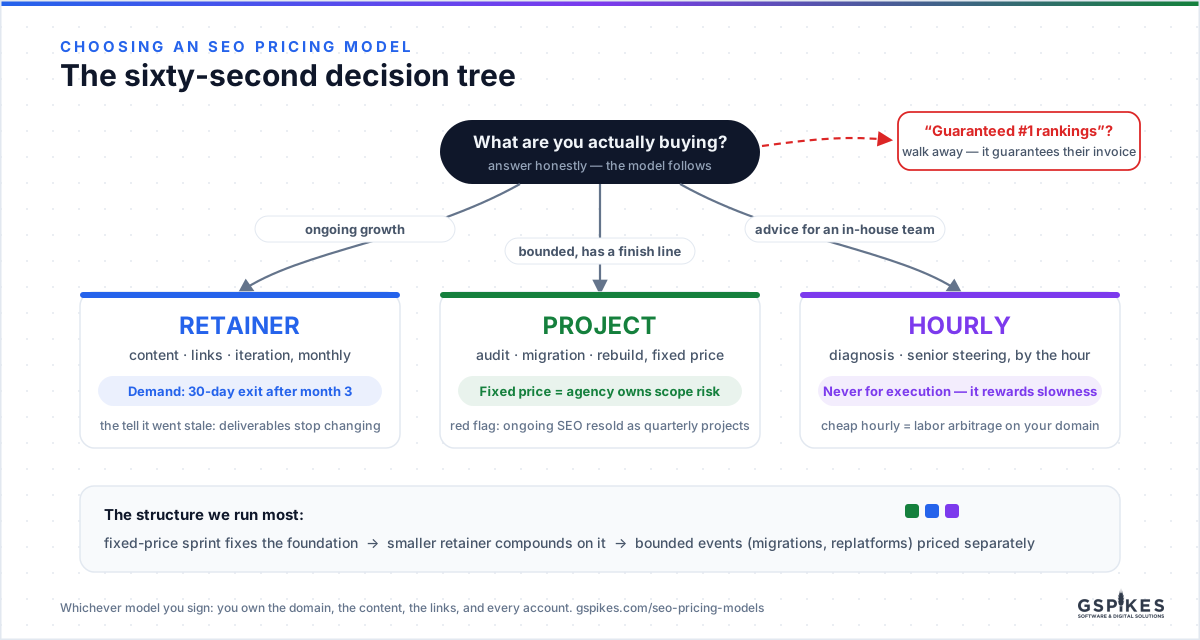
Every SEO contract you’ll ever be offered is one of three models wearing different fonts: a monthly retainer, a fixed-price project, or an hourly rate. Agencies present these as payment logistics. They’re not — they’re incentive structures, and each one quietly decides whose interests the engagement protects. I sell all three, so I’ll show you the machinery from the inside. (If you want the dollar figures instead, those are in what SEO actually costs — this piece is about how the billing shapes the behavior.)
The retainer — right for SEO, easy to abuse
A fixed monthly fee for ongoing work. This is the default model because it matches how SEO actually behaves: rankings compound across quarters, not sprints (here’s the honest timeline), and the work — content, links, technical upkeep, iteration on what the data says — never reaches “done.”
The incentive trap is autopilot. Month one of a retainer is energetic; month nine is where agencies quietly swap senior people for juniors and deliverables for dashboards. The contract kept billing; the work stopped compounding. You detect it with one tell: the deliverables list stops changing. Healthy SEO reacts to data — pages get rebuilt, bets get killed, new clusters get opened. If April’s report is March’s report with new dates, you’re funding a subscription, not a strategy.
A retainer that protects you has four clauses: named deliverables reviewed monthly (not “ongoing optimization”), a 90-day roadmap that updates, reporting tied to pipeline and revenue rather than rankings, and a 30-day exit after an initial three months. Anyone demanding a 12-month lock-in before earning month four is pricing your inability to leave.
The project — right for bounded work, wrong for SEO itself
A fixed price for a defined scope: a technical audit, a migration with rankings protected, a content overhaul, a site rebuild. Fixed pricing transfers scope risk to the agency — which is exactly why it produces disciplined scoping documents and sharp delivery dates. For work with a finish line, it’s the cleanest model there is: you know the cost, they own the risk, everyone can read the definition of done.
The abuse pattern runs the other direction: packaging ongoing SEO as a repeating “project” — a fresh $4,000 engagement every quarter, each one re-auditing what the last one audited. If the scope document could honestly be titled “keep doing SEO,” it’s a retainer being sold in installments, usually because installments hide the absence of a plan.
Hourly — right for advice, wrong for execution
Hourly is the correct model in exactly two situations: diagnosis — a senior specialist auditing something specific, answering hard questions, pressure-testing a strategy — and augmentation, where an in-house team executes and buys expert hours to steer (the economics of that split are in agency vs. in-house).
For execution, hourly is structurally broken: it bills effort instead of outcomes, which rewards slowness and punishes competence. The specialist who fixes your crawl budget in three hours invoices less than the one who takes eleven. Nobody involved needs to be dishonest for that incentive to rot the engagement — the model does it for them. One more signal while we’re here: very cheap hourly SEO is not a bargain, it’s labor arbitrage with your domain as the test site.
“Pay for performance” — the model that guarantees their invoice
Rank-guarantee pricing survives on mechanics, so watch the mechanics: the guarantee attaches to keywords the vendor selects — long-tail phrases nobody searches, where page one is trivially reachable and commercially worthless. The invoice triggers on the ranking, not the revenue. And the tactics used to force fast movement are precisely the ones that draw manual actions, which you’ll later pay someone like me to unwind. When the model’s success metric can be gamed by its seller, the model is the product. Walk.
The hybrids that actually work
- Project → retainer — a fixed-price sprint fixes the foundation, then a smaller retainer compounds on it. This is the structure we run most, because it prices the heavy lift honestly and doesn’t inflate the ongoing fee to amortize it.
- Retainer + project — steady-state SEO on retainer, with genuinely bounded events (a replatform, a domain change) priced separately instead of quietly cannibalizing your monthly deliverables.
- Hourly advisory over in-house hands — your team executes, a senior specialist steers a few hours a month. Highest leverage per dollar of any model on this page, if you have the execution capacity.
Clauses that matter more than the model
Whichever structure you sign: you own everything — content on your domain, links pointing at your domain, and every account (Analytics, Search Console, tag manager) created under your email, not the agency’s. Deliverables live in the contract, not the sales call. Reporting connects work to revenue. And the exit terms are ones you could actually use. Agencies that resist any of those four aren’t protecting the relationship — they’re protecting the renewal.
If you want to see how we’d structure yours — including which model we’d honestly recommend for your situation, which is sometimes the cheapest one — request a free quote and you’ll get a written scope from a senior engineer, not a sales sequence.
Get a number you can plan around
Tell us what you need. A senior strategist replies within one business day with an honest, fixed-price answer — or tells you we're not the right fit.